
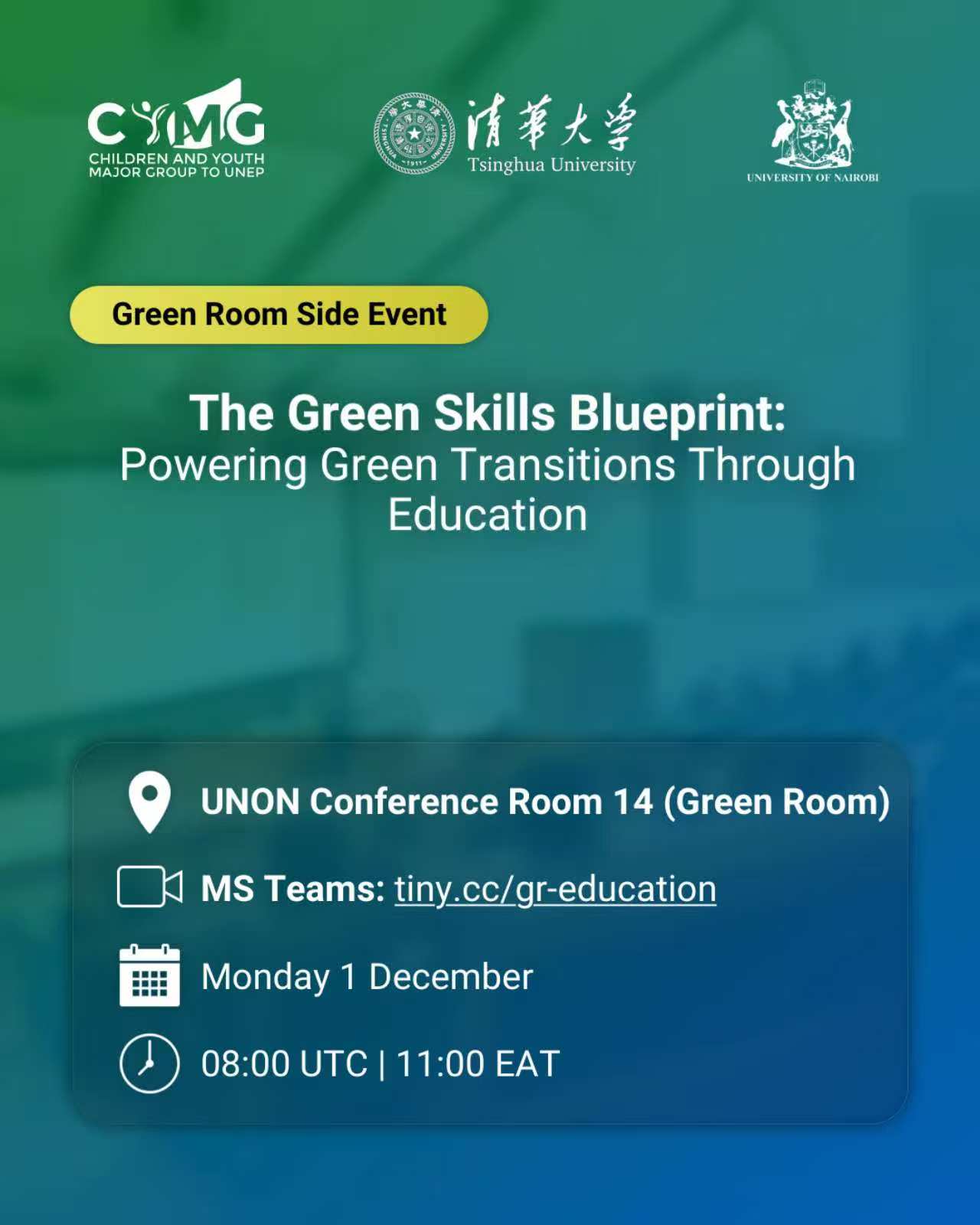
Nairobi, Kenya Dec 1, 2025 - The University of Nairobi (UoN) has championed the need for a comprehensive and inclusive approach to 'green skills' education, moving beyond high-level scientific and technical jobs to focus on the roles essential for the masses. This call was made during a "Green Room Side Event" at the United Nations Environment Assembly (UNEA-7), titled "The Green Skills Blueprint: Powering the Green Transition Through Education." The event was organized by the Children and Youth Major Group to UNEP (CYMG), in collaboration with key partners including Tsinghua University and the University of Nairobi.
Dr. James Kaoga, a from the Institute for Climate Change and Adaptation, highlighted the critical role of academic institutions in addressing the climate crisis. He stressed the need to shift focus from predominantly high-level jobs in engineering, sciences, and technology, which are accessible to only a few, to the low-level and low-skill jobs where the majority of the population are engaged.
"Most of the high level jobs are so much focused on issues to do with engineering, issues to do with the sciences, issues to do with technologies, which only a few people can be able to occupy that space," Dr. Kauga stated. "So our bit is to come in and also look at the low level and low skill jobs, because that is where the masses are". He noted that UoN’s intervention includes capacity building the youth in areas like solarization and carbon credit issues to ensure they are re-skilled and remain relevant in a job market where automation is causing certain jobs to shrink. The Institute is extending its engagement beyond the university to technical and vocational institutions, recognizing the need for a collaborative ecosystem to fight climate change.
The discussion also brought to light the current limitations in climate and sustainability education globally. Speakers noted a significant issue with mainstreaming this education across all fields of study. For instance, undergraduate programmes in fields like engineering or physics might only offer one module of a couple of hours on climate change or sustainability, which was deemed insufficient.
There was a strong consensus on the need to integrate climate change and sustainability topics throughout the entire educational journey, from secondary schools and colleges to bachelor's and master's degrees. Furthermore, the high fees associated with master's level qualifications in sustainability were cited as a significant barrier, making them inaccessible to many who want to contribute to climate change solutions. A speaker from the Global South reinforced this, noting that students often lack exposure to international spaces and paid experiences, often relying on years of volunteering to secure a job in the field.
The side event, running under the theme of "How education is the critical engine for a sustainable future," emphasized that academic institutions have a critical input in this space. The University of Nairobi’s participation underscores its commitment as an academic institution of higher learning to contributing critical input in this space
- Log in to post comments